Pass the physical tests of your Spanish public-service exam with a plan built for your exam day
Spain's National Police, Guardia Civil, Armed Forces and Customs Surveillance run the same physical tests across the whole country. Tell the app your corps, your date and your marks, and the plan counts back, trains every test to the board's standard and gives you your score with the official BOE tables.
Updated
What are the physical tests in Spanish public-service exams?
In Spain, joining the police, the Guardia Civil, the armed forces or the customs service means passing an oposición: a public competitive exam with a written part and a physical part. The physical tests are the part you can't prepare with a textbook, and they decide a lot of places. For the national corps they are the same all over Spain and change little from one call to the next; regional and local police forces set their own. That is why this plan covers the four national corps, with the marks from their latest call in the BOE (Spain's official gazette):
- National Police, Basic Scale and Executive Scale: agility circuit, pull-ups (men) or flexed-arm hang (women) and a 1,000 m run. Each test scores 0 to 10 on a table by sex; you need an average of 5 and a 0 in any test eliminates you. On the Basic Scale the score also counts towards the final ranking.
- Guardia Civil, Corporals and Guards: agility and coordination circuit (C1), push-ups with the chin to the floor, a 2,000 m run and a 50 m swim. It is pass or fail, with different marks by sex and by age bracket (under 35, 35 to 39, and 40 or over).
- Armed Forces: push-ups in two minutes down to a 10 cm pad, a plank, an agility-speed circuit with a seated start and a 2,000 m run; officers, NCOs and the common corps add a 50 m swim. Pass or fail, and the marks rise afterwards, during training.
- Customs Surveillance: 50 m sprint, 800 m run, running long jump and 50 m freestyle with a dive. Each test is eliminatory.
What they have in common is that being fit is not enough to pass them. The circuit is lost to a void for brushing a hurdle or skipping a cone; pull-ups that don't go down to straight arms don't count; neither do push-ups that don't touch the pad; the 1,000 m is lost on the first lap, and the pool catches out anyone who left it for the end. Each test has its technique, its board standard and its pace, and they need training the same way you study the syllabus: with a calendar that ends on exam day.
What each corps asks for
The physical tests of Spain’s national corps are the same everywhere in the country. These are the ones from each latest call, in their official order.
- Score from 0 to 10
National Police · Basic Scale
Your fitness score adds to your exam total: every point counts.
- Agility circuit
- Pull-ups (M) / Flexed-arm hang (W)
- 1,000 m run
- Score from 0 to 10
National Police · Executive Scale
The first test of the process: an average of 5 opens the door.
- Agility circuit
- Pull-ups (M) / Flexed-arm hang (W)
- 1,000 m run
- Pass or fail
Guardia Civil · Corporals and Guards
Pass marks by age: all four, with a margin.
- Agility and coordination circuit (C1)
- Push-ups (chin to the floor)
- Endurance: 2,000 m run
- Water confidence: 50 m freestyle
- Pass or fail
Armed Forces · Enlisted ranks
Pass to get in, and the bar rises at the academy.
- Push-ups (2 min)
- Isometric plank
- Agility-speed circuit
- 2,000 m continuous run
- Pass or fail
Armed Forces · Officers and NCOs
Five tests and a five-year academy: every year, a little more.
- Push-ups (2 min)
- Isometric plank
- Agility-speed circuit
- 2,000 m continuous run
- Water confidence: 50 m
- Pass or fail
Customs Surveillance · Agents
Speed, jump and water: four tests, four doors.
- 50 m sprint
- 800 m run
- Running long jump
- 50 m freestyle with a dive
Your AI-generated plan
When you choose Entrance tests, the app asks for your corps (and the scale, for the police), your sex and your age, the exam date if there is one, and your current marks in each test. As you type them you see the score you would get today, worked out with the BOE table. Then, what you have: a track or a measured loop, a bar, a pool, and whether you can swim or are starting from zero. With that it builds your plan in under a minute.
The plan counts back from the exam. First a base phase to learn the tests and build an engine; then development, with long intervals at 3 km pace and the full circuit flat out; then exam pace, with intervals at your target mark and the circuit under board conditions; and the last week, the taper: less volume, the same intensity, a short activation and rest the day before. With no date yet, the plan moves through base, development and exam pace, stays in exam-pace cycles and reshuffles the phases as soon as you set it.
Every five weeks there is a mock test under the official protocol: the tests in their order, with their attempts, their rules and 8-10 minutes between them. You log your marks and the app gives you your score, compares it with the previous mock test and splits the next cycle: the test that keeps you furthest from a pass gets the most work.
Every test is trained to the board's standard. The circuit, in parts and in full, with its diagram to scale and a home version with two chairs and a broomstick. The bar, from your current step: hanging, negatives, band-assisted and full reps, no kipping and all the way down to straight arms. Push-ups, chin to the pad. The run, with intervals and easy runs at paces worked out from your mark. And the water, from blowing bubbles standing up to 50 m repeats with a turn or a dive.
The rest is what EntrenAI always does: the daily check-in on sleep, stress and fatigue removes sets when you arrive tired (never pace or rest: quality before quantity) and, if needed, swaps the session for mobility; and everything you do goes up to Strava with the result of each test. The Performance panel shows the countdown, your score, the trend of each test and the mark you need for the next point.
From today to the exam, week by week
With the exam date, the plan counts backwards: base, development, exam pace and taper. Every five weeks, a deload with a mock test under the official protocol.
weeks to the exam
- Base
- Development
- Specific
- Taper
- Exam week
Mock test· Exam
- Base: learn the tests and build the engine. Easy runs and aerobic intervals, the circuit in parts, and bar or push-up progressions from your rung.
- Development: aerobic power and speed. Long intervals at 3K pace, the full circuit flat out and more reps to the board's standard.
- Specific: exam pace. Intervals at your target pace, the circuit under exam conditions and bar sets like the board's.
- Taper. Less volume, same intensity: arrive fresh without losing the edge.
- Exam week. Short activation, rest the day before and everything ready for test day.
Without an exam date, the plan moves through base, development and exam pace, with a mock test every five weeks, and reshuffles the phases as soon as you set the date.
Who is this plan for?
-
You are starting out with no marks: the first week brings an initial assessment, a no-pressure mock test with your corps' tests, and your plan comes out of it. Nobody asks you how fast you run 1,000 m before you start.
-
You failed a test before: the plan puts that test at the centre. If it was the bar, a progression from your step; if it was the circuit, hurdle and turn technique and lots of full reps; if it was the water, swim sessions from your real level.
-
You are a few weeks from the exam: with the date, the app tells you which phase you are in and adjusts the weeks left. You can't build an engine in three weeks, but you can sharpen your pace, polish your technique and arrive fresh.
-
Women: the tests and marks change (flexed-arm hang instead of pull-ups for the police, other marks everywhere) and the plan uses yours from day one.
-
Over 35 in the Guardia Civil: your marks are those of your age bracket on test day, and the app switches them on its own if you have a birthday before the exam.
-
No track, no bar or no pool: the plan adapts what is missing (a loop measured with your phone, a door-frame bar, the circuit set up at home) and tells you what has no substitute, like the pool in an exam with a swim.
Work out your physical test score
Enter your marks the way the board would time them. Longer times in minutes and seconds (3:24).
Enter every mark to see the full score.
Calculated in your browser: nothing is stored.
How each test is done
The same drawings you see in the app, with the BOE measurements: the circuit route and what the board checks on every rep.
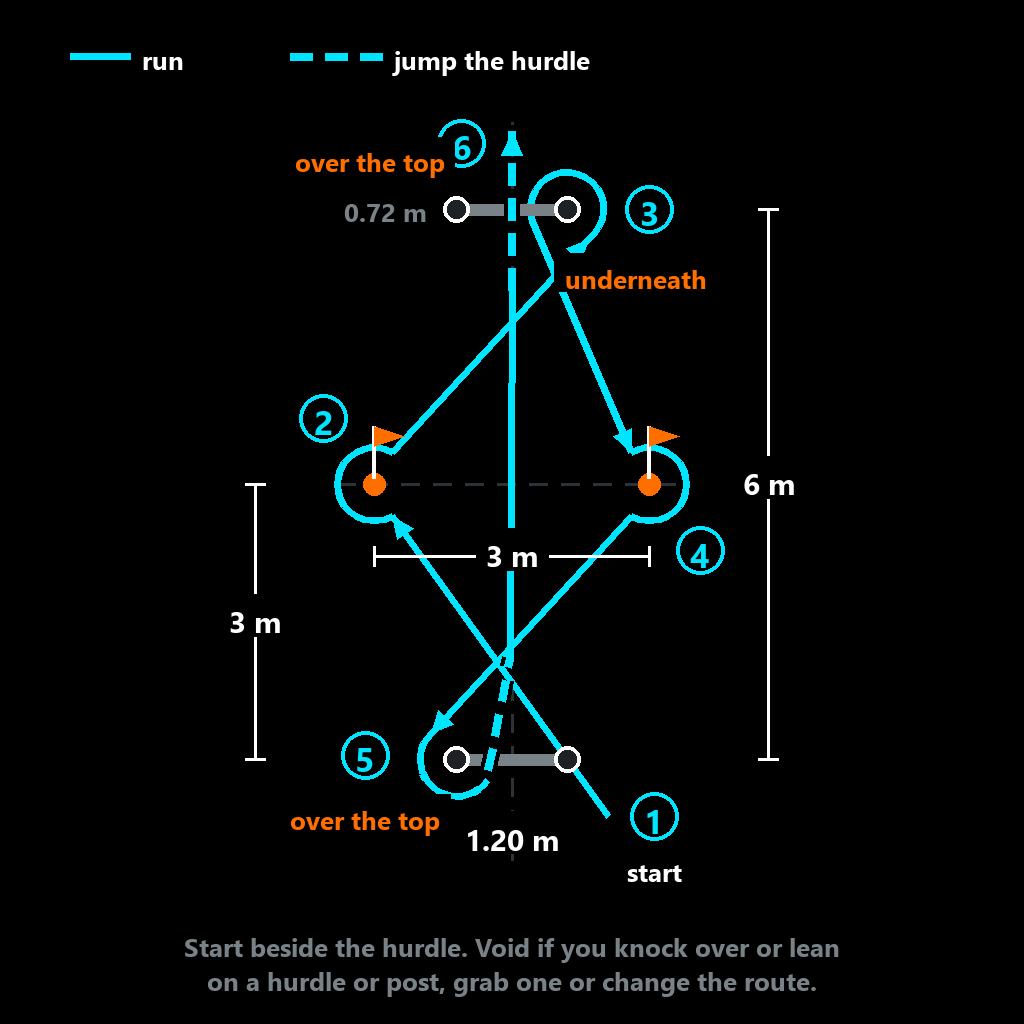
National Police agility circuit diagram: hurdles 6 m apart, posts 3 m apart, under and over the hurdles 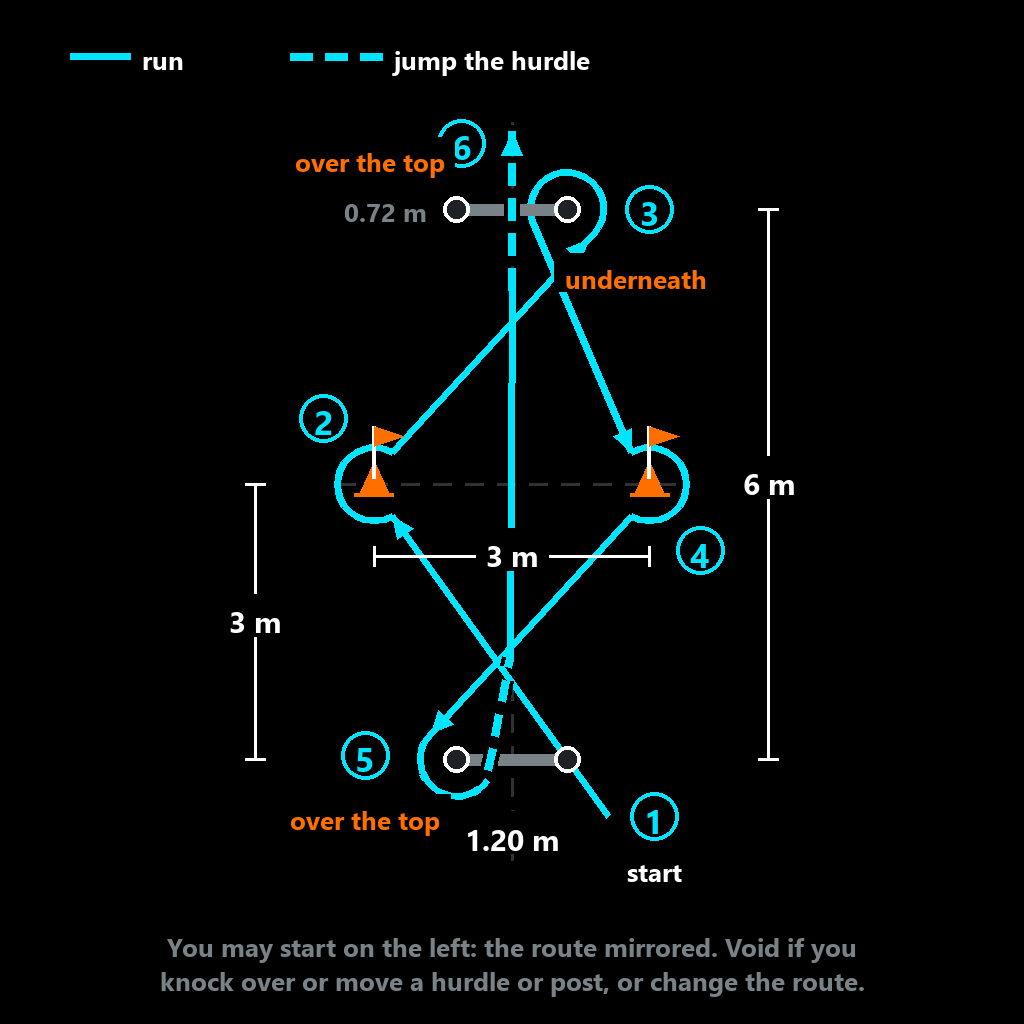
Guardia Civil C1 circuit diagram, with the measurements from the BOE 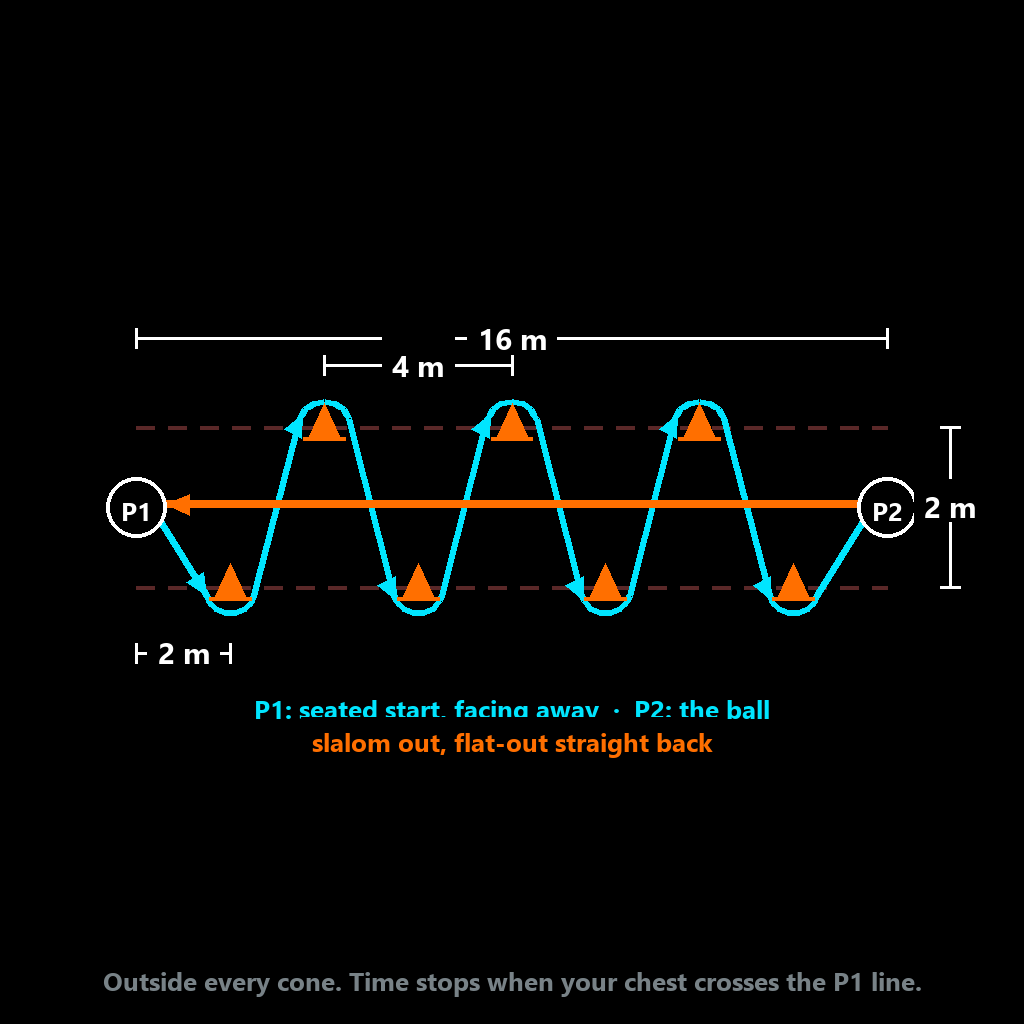
Armed Forces agility-speed circuit diagram: seated start, seven-cone slalom and straight run back
Your first weeks, in detail
Week 12
National Police, man, intermediate, 4 days: development, load week (exam in 9 weeks)| Day | Session type | Detail | Duration |
|---|---|---|---|
| Monday | Easy run | Easy run 45 min, 80 m strides 4×80 m, Exam-standard pull-ups 3×3 | 65 min |
| Tuesday | Strength | Back squat 4×6, Romanian deadlift 3×8, Weighted step-ups 2×8 per leg, Exam-standard pull-ups 5×4, Top hold (chin over the bar) 3×10 s, Dumbbell row 3×10, Plank 3×30-45 s, Calf raise 2×12, Tibialis raise 2×15 | 58 min |
| Wednesday | Rest | Recovery | — |
| Thursday | Agility circuit | Under-the-hurdle pass (65 cm) 6×1, Tight turn round the post 4×1 per side, National Police agility circuit 6×1 flat out, 10-20 m sprint 4×10 m, Exam-standard pull-ups 3×3 | 56 min |
| Friday | Rest | Recovery | — |
| Saturday | Running intervals | High-knee skips 2×20 m, Butt kicks 2×20 m, Intervals 5×800 m | 47 min |
| Sunday | Rest | Recovery | — |
Week 20
Guardia Civil, woman, beginner, 4 days: taper (exam in 1 week)| Day | Session type | Detail | Duration |
|---|---|---|---|
| Monday | Easy run | Easy run 19 min, 80 m strides 4×80 m | 34 min |
| Tuesday | Agility circuit | Under-the-hurdle pass (65 cm) 6×1, Guardia Civil C1 circuit 3×1 flat out | 34 min |
| Wednesday | Rest | Recovery | — |
| Thursday | Running intervals | High-knee skips 2×20 m, Butt kicks 2×20 m, Exam-pace rehearsal 3×600 m, Fast reps 2×150 m, Back squat 2×5, Romanian deadlift 2×8, Plank 2×30 s | 50 min |
| Friday | Rest | Recovery | — |
| Saturday | Swim | Kickboard kick 2×25 m, Freestyle breathing every 3 strokes 5×25 m, Swim repeats 2×50 m, Touch turn 2×1, Exam push-ups: chin to the floor 3×4 | 31 min |
| Sunday | Rest | Recovery | — |
These examples are real extracts from the EntrenAI planning engine. Your personal plan adjusts to your level, equipment and availability.
Equipment needed
EntrenAI automatically substitutes any exercise if you don’t have the gear.
- An athletics track or a measured 400 m loop for the 1,000 m, 2,000 m or 800 m intervals
- For the circuit, two hurdles or two chairs with a broomstick at 65 cm and 72 cm, and two cones or bottles; for the Armed Forces, seven cones and a tennis ball
- A pull-up bar (a door-frame one works at home), no gloves or chalk, as in the police exam
- A pad or a folded towel of 6 to 10 cm for the Guardia Civil and Armed Forces push-ups
- A 25 m pool if your corps has a swim: Guardia Civil, Armed Forces officers and Customs
- The stopwatch on your phone and, better still, someone who times you the way the board would
What most people get wrong (and how to avoid it)
- 1
Running a lot and not training the circuit
The circuit tends to get little training and is lost to technique, not fitness: a knocked hurdle, leaning on a hurdle or a wide turn at the post. For the National Police it is also the first test and the tie-breaker. The plan works on it in parts every week and flat out in full as soon as your technique holds.
- 2
Kipping or half pull-ups
The board only counts a pull-up that starts from fully straight arms with a still body and clearly takes the chin over the bar. Swinging reps or reps that don't go all the way down don't count, and on exam day you notice the difference between 12 gym pull-ups and 12 board pull-ups. The plan trains them to the standard from day one.
- 3
Going flat out on the first lap
In the 1,000 m and 2,000 m the mark is lost in the first 200 metres: you go with whoever is in front and pay for it on the last lap. The plan's intervals are at your target pace and the mock test teaches you how to split the race.
- 4
Leaving the swim for the end
Swimming 50 m fast can't be learned in three weeks if you didn't swim as a child. Breathing to the side, breathing out underwater and turning without holding the edge take months. The plan brings swimming in from the first week, at your level.
- 5
Not rehearsing the order and the rests
On exam day the tests come one after another, with waiting and nerves. Reaching the 2,000 m with circuit legs is not like running it fresh. That is why the mock test repeats the official order and rests, and why it comes every five weeks.
- 6
Pushing hard in exam week
Nothing is gained in the last week and a lot can be lost. The plan cuts volume, keeps intensity so you don't lose your sharpness, does a short activation two days before and leaves the day before blank.
- 7
Forgetting the medical certificate or the medical check
Without the medical certificate the call asks for, you don't get into the tests, and afterwards comes a medical check with BMI limits. The app shows what your corps asks for and reminds you on exam day.
Entrance tests plans by goal and level
- Spanish National Police physical tests: the plan to score high in the circuit, the bar and the 1,000 mA plan for the Spanish National Police physical tests (Basic Scale): circuit, pull-ups or hang and 1,000 m, with the official scoring table and your score at every mock test.
- Spanish National Police Inspector physical tests: pass first time without stealing hours from the syllabusA plan for the physical tests of the Spanish National Police Executive Scale (Inspector): circuit, bar and 1,000 m with the official table, compatible with studying.
- Guardia Civil physical tests: all four with a margin, with the marks for your ageA plan for the Guardia Civil physical tests (Corporals and Guards): C1 circuit, push-ups, 2,000 m and 50 m swim, with the marks for your sex and your age bracket.
- Spanish Armed Forces enlisted physical tests: pass to get in and be ready when the bar risesA plan for the Spanish Armed Forces enlisted physical tests under Order DEF/15/2026: 2-minute push-ups, plank, seated-start circuit and 2,000 m, with your marks.
- Spanish Armed Forces officer and NCO physical tests: five tests and an academy aheadA plan for the physical tests of Spanish Armed Forces officers, NCOs, common corps and Medicine: five tests including a swim, with the Order DEF/15/2026 marks.
- Spanish Customs Surveillance physical tests: speed, jump and water, all four with a marginA plan for the Spanish Customs Surveillance agent physical tests: 50 m, 800 m, running long jump and 50 m freestyle with a dive, with the official marks.
Frequently asked questions
For the national corps, yes: the National Police, Guardia Civil, Armed Forces and Customs Surveillance run nationwide calls and their tests are the same for every candidate. Regional police forces (Mossos, Ertzaintza, Policía Foral) and local police set their own in each call, which is why this plan doesn't cover them.
Each test (circuit, pull-ups or flexed-arm hang, and 1,000 m) scores 0 to 10 on the BOE table for your sex. You need an average of 5 and a 0 in any test eliminates you. On the Basic Scale the score is added to the knowledge exam for the final ranking; ties are broken by the knowledge test, then the fitness score, then the circuit. On the Executive Scale it is pass or fail with the same table.
You enter an approximate date or none. With no date, the plan moves through base, development and exam pace, with a mock test every five weeks, and stays at exam pace; when the call comes out and you set the date, it reshuffles the phases so the taper lands in the last week.
Almost everything, yes. Intervals work on any measured loop, the circuit can be set up at home with two chairs, a broomstick and two bottles, and a door-frame bar does for the bar. What has no substitute is the water: if your corps has a swim, the plan needs you to go to a pool, and it tells you so from the start.
The first week brings an initial assessment: a mock test with your corps' tests, without pressure, that gives you your starting marks and your first score. The plan adjusts to whatever comes out.
Not directly: their tests change with each call. If yours are similar (a circuit, a run, a bar test), you can pick the closest national corps and the work will carry over, but the score and pass marks won't be yours.
From each corps' latest call published in the BOE, which the app links in your panel. When a new call comes out it is checked and, if anything changes, the app is updated. The date of the last check is in each corps' table of tests.
Yes. It is one more EntrenAI sport, with the same 7-day free trial and the same price as the rest: €7.99 a month or €23.99 a year, cancel any time.
Start your personalized plan today
Download EntrenAI, answer 8 questions, and the AI generates your plan in under 60 seconds. Cancel anytime.
Other plans you might like
AI-built running plan, from 5K to marathon
A running plan tailored to your level, goal distance and weekly availability: polarized 80/20 training, VDOT pace zones and daily AI recalibration.
Get faster for your sport: an AI speed and power plan
AI speed and power plan for football, basketball, rugby, handball, tennis and padel: sprinting, jumping and change of direction built around your matches.