Spanish Armed Forces officer and NCO physical tests: five tests and an academy ahead
Push-ups, plank, circuit, 2,000 metres and a 50 metre swim. The marks differ between the General Corps, the common corps and Medicine, and rise at the academy. The plan uses yours and shows you the ones that come next.
Updated
What are the physical tests for officers and NCOs?
To join the officer and NCO scales of the Spanish Armed Forces, Order DEF/15/2026 (BOE of 21 January 2026) sets five tests: push-ups in two minutes, isometric plank, agility-speed circuit, 2,000 metres and a 50 metre swim. The first four go in that order and the swim is separate. All are pass or fail, but the marks depend on what you are applying for:
- Officers and NCOs (General Corps and Marines; also Guardia Civil officers by direct entry): 18 push-ups for men and 10 for women, a 44-second plank, 15.0 and 16.7 s in the circuit, 10:10 and 11:14 in the 2,000 m, and 1:00 and 1:08 in the swim.
- Supply, Engineers and the Common Corps (Legal, Audit, Medical Corps except Medicine without a degree, and Military Music): 9 and 6 push-ups, a 44 s plank, 15.6 and 17.0 s in the circuit, 11:38 and 12:02 in the 2,000 m, and 1:22 and 1:35 in the swim.
- Medicine without a prior degree: 14 and 7 push-ups, a 44 s plank, 15.6 and 16.9 s in the circuit, 10:42 and 11:46 in the 2,000 m, and 1:11 and 1:21 in the swim.
And a detail that gets forgotten: if the call requires a university or advanced vocational degree, you are asked for the marks of the year before the one you join, not the entry marks.
The first four are the same tests as for enlisted ranks, with different marks: push-ups down to the 10 cm pad with a single rest, a forearm plank (the second break in form ends it), and the 16 metre circuit with a seated start facing away, a seven-cone slalom, a tennis ball and a straight run back. The swim is any stroke, in a pool of at least 25 metres; you may start in the water, but you may not stop, hold the lane rope or the edge, or push off the bottom, and you must touch the wall at the turn. One attempt, with one false start allowed.
The marks rise during the academy. For Officers and NCOs, at the end of the first year they ask for 20 push-ups (12 for women), a 48 s plank, 14.8 s in the circuit (16.5), 9:54 in the 2,000 m (10:56) and 59 s in the swim (1:07).
The tests for Armed Forces · Officers and NCOs
Pass or fail at the entry marks. If the call requires a degree or higher technical diploma, you are held to the marks of the year before the one you join.
Order: Push-ups, plank, circuit and 2,000 m, in that order; the swim separately.
| Test | Men | Women |
|---|---|---|
| Push-ups (2 min) | 18 | 10 |
| Isometric plank | 44 s | 44 s |
| Agility-speed circuit | 15.0 s | 16.7 s |
| 2,000 m continuous run | 10:10 | 11:14 |
| Water confidence: 50 m | 1:00 | 1:08 |
Push-ups (2 min)
Attempts: Two attempts, spaced to recover.
- As many as you can in two minutes at most.
- A rep counts when the chin touches the 10 cm pad and you return to fully straight arms.
- Hands under the shoulders, legs together, body straight from head to heels.
- A single rest, in the top position; the second stop ends the test.
Isometric plank
Attempts: Two attempts, spaced to recover.
- Forearms and toes on the floor, elbows under the shoulders.
- Body straight from head to heels, legs together.
- The hips neither rise nor sag; the forearms stay put.
- The first break in form earns a warning; the second ends the test.
Agility-speed circuit
Attempts: Two attempts, spaced to recover.
- Seated start, back to the course and hands on the knees; the start call comes from behind.
- Out: slalom outside the seven cones, starting with the nearest; pick up the tennis ball.
- Back: straight line, flat out; time stops when your chest crosses the line.
- Repeated if you knock or move a cone, drop the ball or go wrong. One false start per attempt.
2,000 m continuous run
Attempts: One attempt.
- Standing start.
- A flat, firm, even loop of at least 300 m.
Water confidence: 50 m
Attempts: One attempt; one false start allowed.
- Any stroke, in a pool of at least 25 m; you may start in the water.
- No stopping, no holding the lane rope or the edge, no pushing off the bottom.
- You must touch the wall at the turn.
The bar rises afterwards: At the end of the first year
- Push-ups (2 min): 20 (men) · 12 (women)
- Isometric plank: 48 s (men) · 48 s (women)
- Agility-speed circuit: 14.8 s (men) · 16.5 s (women)
- 2,000 m continuous run: 9:54 (men) · 10:56 (women)
- Water confidence: 50 m: 59 s (men) · 1:07 (women)
What else they ask for
- Medical standards of Order PCI/6/2019: BMI between 17 and 30 and a urine test.
Source
Order DEF/15/2026 of 13 January (BOE of 21 January), annexes I and III. Repeals Order DEF/1078/2012.
BOE-A-2026-1379Rules checked on 2026-09-23.
The tests for Armed Forces · Supply, Engineers and Common Corps
Pass or fail at the entry marks for these corps (annex III, sections three and four).
Order: Push-ups, plank, circuit and 2,000 m, in that order; the swim separately.
| Test | Men | Women |
|---|---|---|
| Push-ups (2 min) | 9 | 6 |
| Isometric plank | 44 s | 44 s |
| Agility-speed circuit | 15.6 s | 17.0 s |
| 2,000 m continuous run | 11:38 | 12:02 |
| Water confidence: 50 m | 1:22 | 1:35 |
Push-ups (2 min)
Attempts: Two attempts, spaced to recover.
- As many as you can in two minutes at most.
- A rep counts when the chin touches the 10 cm pad and you return to fully straight arms.
- Hands under the shoulders, legs together, body straight from head to heels.
- A single rest, in the top position; the second stop ends the test.
Isometric plank
Attempts: Two attempts, spaced to recover.
- Forearms and toes on the floor, elbows under the shoulders.
- Body straight from head to heels, legs together.
- The hips neither rise nor sag; the forearms stay put.
- The first break in form earns a warning; the second ends the test.
Agility-speed circuit
Attempts: Two attempts, spaced to recover.
- Seated start, back to the course and hands on the knees; the start call comes from behind.
- Out: slalom outside the seven cones, starting with the nearest; pick up the tennis ball.
- Back: straight line, flat out; time stops when your chest crosses the line.
- Repeated if you knock or move a cone, drop the ball or go wrong. One false start per attempt.
2,000 m continuous run
Attempts: One attempt.
- Standing start.
- A flat, firm, even loop of at least 300 m.
Water confidence: 50 m
Attempts: One attempt; one false start allowed.
- Any stroke, in a pool of at least 25 m; you may start in the water.
- No stopping, no holding the lane rope or the edge, no pushing off the bottom.
- You must touch the wall at the turn.
The bar rises afterwards: At the end of training (one year)
- Push-ups (2 min): 13 (men) · 7 (women)
- Isometric plank: 50 s (men) · 50 s (women)
- Agility-speed circuit: 15.4 s (men) · 16.9 s (women)
- 2,000 m continuous run: 11:06 (men) · 11:46 (women)
- Water confidence: 50 m: 1:19 (men) · 1:34 (women)
What else they ask for
- Medical standards of Order PCI/6/2019: BMI between 17 and 30 and a urine test.
Source
Order DEF/15/2026 of 13 January (BOE of 21 January), annexes I and III. Repeals Order DEF/1078/2012.
BOE-A-2026-1379Rules checked on 2026-09-23.
The tests for Armed Forces · Medical Corps, Medicine (no degree)
Pass or fail at the entry marks for Medicine without a previous degree (annex III, section four, point 4).
Order: Push-ups, plank, circuit and 2,000 m, in that order; the swim separately.
| Test | Men | Women |
|---|---|---|
| Push-ups (2 min) | 14 | 7 |
| Isometric plank | 44 s | 44 s |
| Agility-speed circuit | 15.6 s | 16.9 s |
| 2,000 m continuous run | 10:42 | 11:46 |
| Water confidence: 50 m | 1:11 | 1:21 |
Push-ups (2 min)
Attempts: Two attempts, spaced to recover.
- As many as you can in two minutes at most.
- A rep counts when the chin touches the 10 cm pad and you return to fully straight arms.
- Hands under the shoulders, legs together, body straight from head to heels.
- A single rest, in the top position; the second stop ends the test.
Isometric plank
Attempts: Two attempts, spaced to recover.
- Forearms and toes on the floor, elbows under the shoulders.
- Body straight from head to heels, legs together.
- The hips neither rise nor sag; the forearms stay put.
- The first break in form earns a warning; the second ends the test.
Agility-speed circuit
Attempts: Two attempts, spaced to recover.
- Seated start, back to the course and hands on the knees; the start call comes from behind.
- Out: slalom outside the seven cones, starting with the nearest; pick up the tennis ball.
- Back: straight line, flat out; time stops when your chest crosses the line.
- Repeated if you knock or move a cone, drop the ball or go wrong. One false start per attempt.
2,000 m continuous run
Attempts: One attempt.
- Standing start.
- A flat, firm, even loop of at least 300 m.
Water confidence: 50 m
Attempts: One attempt; one false start allowed.
- Any stroke, in a pool of at least 25 m; you may start in the water.
- No stopping, no holding the lane rope or the edge, no pushing off the bottom.
- You must touch the wall at the turn.
The bar rises afterwards: At the end of the first year
- Push-ups (2 min): 15 (men) · 8 (women)
- Isometric plank: 48 s (men) · 48 s (women)
- Agility-speed circuit: 15.4 s (men) · 16.8 s (women)
- 2,000 m continuous run: 10:26 (men) · 11:30 (women)
- Water confidence: 50 m: 1:10 (men) · 1:20 (women)
What else they ask for
- Medical standards of Order PCI/6/2019: BMI between 17 and 30 and a urine test.
Source
Order DEF/15/2026 of 13 January (BOE of 21 January), annexes I and III. Repeals Order DEF/1078/2012.
BOE-A-2026-1379Rules checked on 2026-09-23.
Your AI-generated plan
You choose the Armed Forces and your scale (Officers and NCOs, Common Corps or Medicine), your sex, the date, your marks and your level in the water. The app tells you which tests you pass today, which are close and how far you are from the academy bar.
A five-day week has strength, an easy run, the circuit, a swim and intervals for the 2,000 m, with push-ups and the plank spread over several sessions. The split follows the risk: whatever is a fail comes first, then whatever is close, and comfortable tests are maintained.
The circuit is trained in parts: the seated start turning towards the first cone, the slalom with short steps at each cone and the straight run back; then full reps with the BOE diagram. Push-ups and the plank, from your step, with one max set on a two-minute clock at the end of each peak week. The water, from your level: from learning to breathe and kickboard kicks to 25 and 50 m repeats at your target time and turns touching the wall.
Every five weeks, a mock test with the four tests in order and the swim separately, and in exam week, the taper.
From today to the exam, week by week
With the exam date, the plan counts backwards: base, development, exam pace and taper. Every five weeks, a deload with a mock test under the official protocol.
weeks to the exam
- Base
- Development
- Specific
- Taper
- Exam week
Mock test· Exam
- Base: learn the tests and build the engine. Easy runs and aerobic intervals, the circuit in parts, and bar or push-up progressions from your rung.
- Development: aerobic power and speed. Long intervals at 3K pace, the full circuit flat out and more reps to the board's standard.
- Specific: exam pace. Intervals at your target pace, the circuit under exam conditions and bar sets like the board's.
- Taper. Less volume, same intensity: arrive fresh without losing the edge.
- Exam week. Short activation, rest the day before and everything ready for test day.
Without an exam date, the plan moves through base, development and exam pace, with a mock test every five weeks, and reshuffles the phases as soon as you set the date.
Who is this plan for?
-
Officer and NCO candidates for the General Corps and the Marines, and Guardia Civil officer candidates by direct entry, who take these same tests.
-
Candidates for Supply, Engineers, Legal, Audit, the Medical Corps or Military Music, with more accessible entry marks but the same five-test exam.
-
Candidates for Medicine without a prior degree, with six years ahead: it pays to get in with a margin.
-
Those joining with a degree: you are asked for the marks of the year before the one you join, higher than the entry marks. The app shows you your scale's academy bar so you know how far you are.
Work out your physical test score
Enter your marks the way the board would time them. Longer times in minutes and seconds (3:24).
Enter every mark to see the full score.
Calculated in your browser: nothing is stored.
How each test is done
The same drawings you see in the app, with the BOE measurements: the circuit route and what the board checks on every rep.
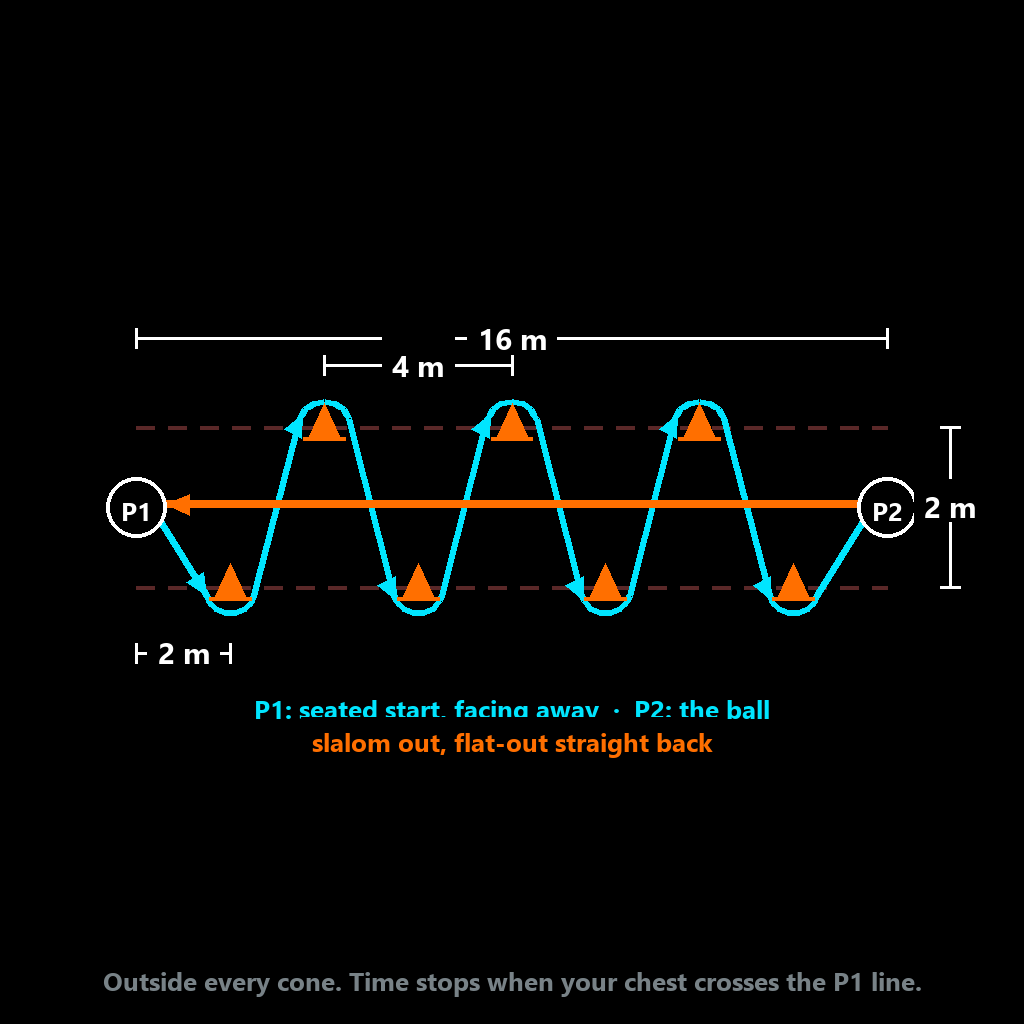
Armed Forces agility-speed circuit diagram: seated start, seven-cone slalom and straight run back 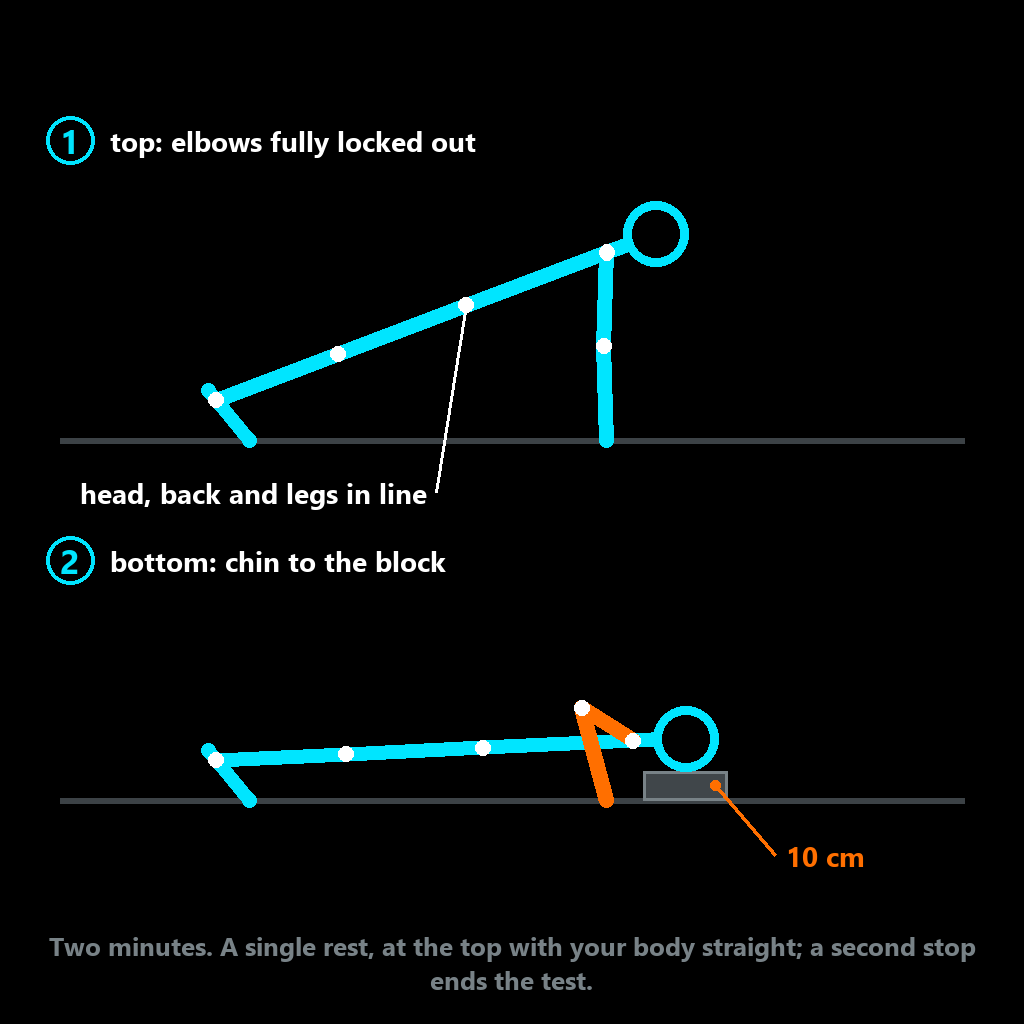
Armed Forces push-ups: chin to the 10 cm block
Your first weeks, in detail
Week 12
Armed Forces (officers and NCOs), man, advanced, 5 days: development, load week (exam in 9 weeks)| Day | Session type | Detail | Duration |
|---|---|---|---|
| Monday | Strength | Back squat 4×5, Romanian deadlift 3×8, Weighted step-ups 2×8 per leg, Exam push-ups: 10 cm pad 8×15, Backpack push-ups 3×8, Exam-standard plank 4×58 s, Side plank 2×30 s per side, Calf raise 2×12, Tibialis raise 2×15 | 63 min |
| Tuesday | Easy run | Easy run 50 min, Exam push-ups: 10 cm pad 3×14 | 65 min |
| Wednesday | Agility circuit | Seated start facing away 4×1, Cone slalom 3×1 out, Armed Forces agility-speed circuit 7×1 flat out | 45 min |
| Thursday | Rest | Recovery | — |
| Friday | Swim | Easy continuous swim 200 m, Swim repeats 8×25 m, Swim repeats 4×50 m, Touch turn 3×1 | 36 min |
| Saturday | Running intervals | High-knee skips 2×20 m, Butt kicks 2×20 m, Intervals 6×1000 m, Exam-standard plank 2×45 s | 62 min |
| Sunday | Rest | Recovery | — |
Week 19
Armed Forces (officers and NCOs), woman, intermediate, 3 days: specific, deload and mock test (exam in 2 weeks)| Day | Session type | Detail | Duration |
|---|---|---|---|
| Monday | Easy run | Easy run 24 min, Exam push-ups: 10 cm pad 2×7, Incline push-ups (hands on a bench) 2×12, Exam-standard plank 2×39 s, Side plank 2×30 s per side, Exam-standard plank 2×30 s | 46 min |
| Tuesday | Swim | Kickboard kick 2×25 m, Freestyle breathing every 3 strokes 4×25 m, Swim repeats 2×50 m, Touch turn 2×1, Exam push-ups: 10 cm pad 2×5, Back squat 2×5, Romanian deadlift 2×8, Plank 2×30 s | 36 min |
| Wednesday | Rest | Recovery | — |
| Thursday | Mock test | The tests in order, under the official protocol: Push-ups (2 min), Isometric plank, Agility-speed circuit, 2,000 m continuous run, Water confidence: 50 m | 86 min |
| Friday | Rest | Recovery | — |
| Saturday | Rest | Recovery | — |
| Sunday | Rest | Recovery | — |
These examples are real extracts from the EntrenAI planning engine. Your personal plan adjusts to your level, equipment and availability.
Equipment needed
EntrenAI automatically substitutes any exercise if you don’t have the gear.
- A track or a flat loop of at least 300 metres for the 2,000 m
- Seven cones and a tennis ball for the circuit, in a 16 by 2 metre lane
- A 10 cm block or pad for the push-ups
- A pool of at least 25 metres, goggles and a cap
- A mat for the plank and a weighted backpack for weighted push-ups
- The stopwatch on your phone
What most people get wrong (and how to avoid it)
- 1
Looking at another scale's marks
Between the General Corps and the Common Corps there are nine push-ups of difference for men and almost a minute and a half in the 2,000 m. And if you join with a degree, you are asked for the marks of the previous year. Check which ones are yours: the app uses them throughout the plan.
- 2
Leaving the swim for the end
One minute for 50 metres can't be improvised. Even if you can start in the water and swim any stroke, you may not stop or hold on, and the turn requires touching the wall.
- 3
Stopping twice in the push-ups
There is only one rest, at the top. A second stop ends the test. The plan trains the max set on a two-minute clock so you know where to take that rest.
- 4
Letting the hips sag in the plank
The second break in form ends it. With a 44-second minimum, the plank is not the hard test, but it is lost on posture.
- 5
Getting in by the skin of your teeth
At the end of the first year they ask for more in every test. Getting in with a margin means not reaching the academy with homework.
Other Entrance tests plan variants
Back to the general Entrance tests plan
- Spanish National Police physical tests: the plan to score high in the circuit, the bar and the 1,000 mA plan for the Spanish National Police physical tests (Basic Scale): circuit, pull-ups or hang and 1,000 m, with the official scoring table and your score at every mock test.
- Spanish National Police Inspector physical tests: pass first time without stealing hours from the syllabusA plan for the physical tests of the Spanish National Police Executive Scale (Inspector): circuit, bar and 1,000 m with the official table, compatible with studying.
- Guardia Civil physical tests: all four with a margin, with the marks for your ageA plan for the Guardia Civil physical tests (Corporals and Guards): C1 circuit, push-ups, 2,000 m and 50 m swim, with the marks for your sex and your age bracket.
- Spanish Armed Forces enlisted physical tests: pass to get in and be ready when the bar risesA plan for the Spanish Armed Forces enlisted physical tests under Order DEF/15/2026: 2-minute push-ups, plank, seated-start circuit and 2,000 m, with your marks.
- Spanish Customs Surveillance physical tests: speed, jump and water, all four with a marginA plan for the Spanish Customs Surveillance agent physical tests: 50 m, 800 m, running long jump and 50 m freestyle with a dive, with the official marks.
Frequently asked questions
Five: push-ups in two minutes, isometric plank, agility-speed circuit, 2,000 metres and a 50 metre swim. They are those of Order DEF/15/2026.
No. Officers and NCOs of the General Corps and the Marines have the most demanding ones; Supply, Engineers and the common corps the most accessible; and Medicine without a degree, somewhere in between. The full tables are on this page.
50 metres any stroke in a pool of at least 25 metres. You may start in the water. You may not stop, hold the lane rope or the edge, or push off the bottom, and you must touch the wall at the turn. One attempt, with one false start allowed.
If the call requires a university or advanced vocational degree, you are asked for the marks of the year before the one you join, which are higher than the entry marks.
Yes: direct entry to Guardia Civil officer uses the Armed Forces officer tests, with the same marks.
Start your personalized plan today
Download EntrenAI, answer 8 questions, and the AI generates your plan in under 60 seconds. Cancel anytime.
Other plans you might like
Pass the physical tests of your Spanish public-service exam with a plan built for your exam day
A plan for the physical tests of Spain's National Police, Guardia Civil, Armed Forces and Customs: countdown to the exam, mock tests and your official score.
AI-built swimming training plan
A swimming training plan tuned to your level and goal: technique, aerobic base and speed, with T-pace sets and AI adjustments after every session you log.
AI-built running plan, from 5K to marathon
A running plan tailored to your level, goal distance and weekly availability: polarized 80/20 training, VDOT pace zones and daily AI recalibration.